

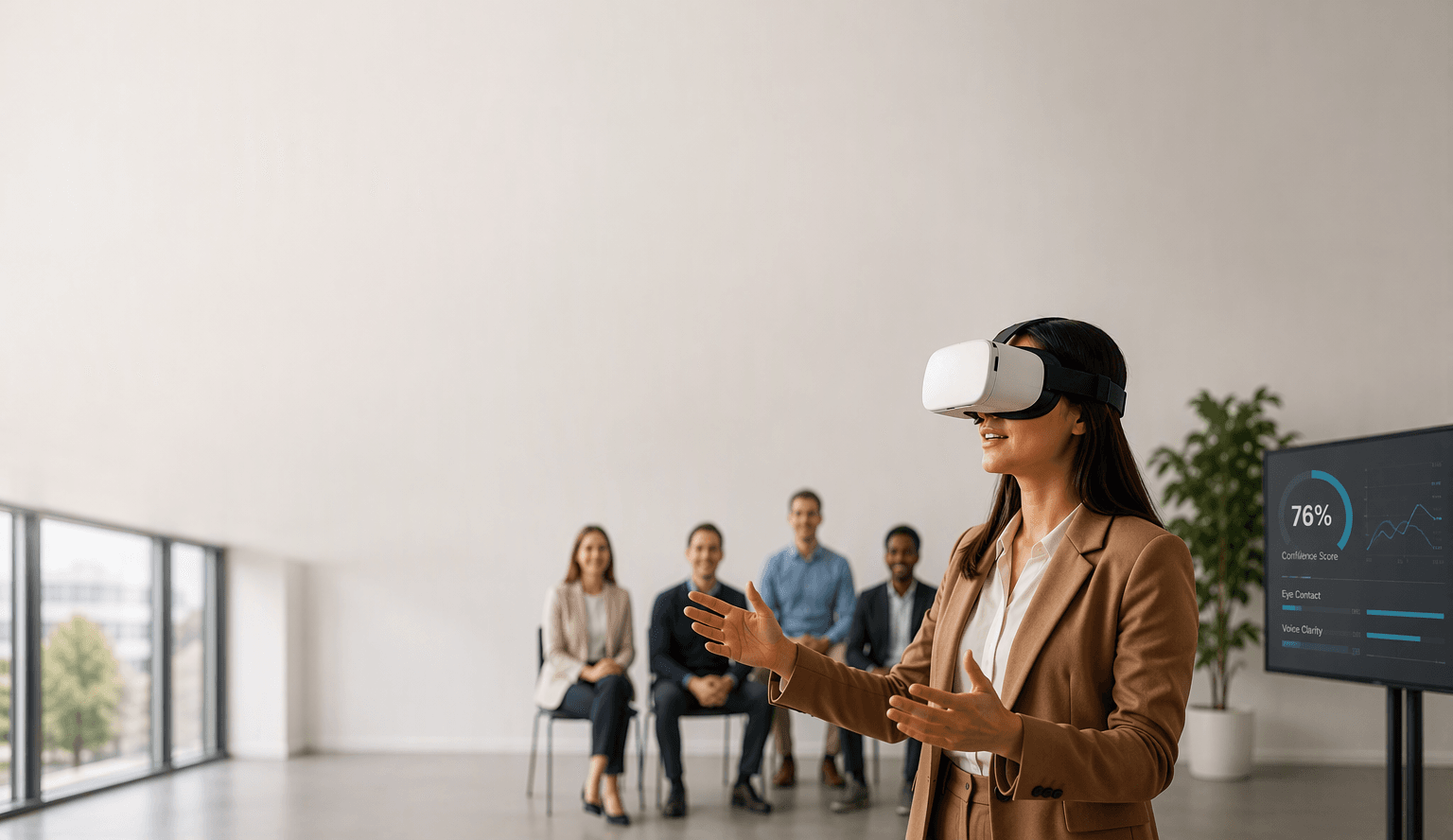
Imagine standing in front of a room full of people. All eyes are on you as you begin your presentation. You speak a little too quickly. You avoid eye contact. Perhaps you say “um” more often than you realize. Then you remove your headset. The audience disappears.
This experience captures the promise of virtual reality (VR) as a learning tool. In our 2026 study, Virtual reality in marketing education: Experiences, challenges, and the development of the 3E framework for presentation skills training, published in Marketing Education Review, we explored what happens when VR moves beyond games and demonstrations and becomes part of everyday university teaching.
Our focus was on one of the most important transferable skills that marketing students need: the ability to present ideas clearly, confidently, and persuasively. Presentation skills are a particularly interesting educational challenge because improvement comes largely through practice. The more you present, the better you become. Yet for many students, especially those presenting in a second language, speaking in front of an audience can be intimidating.
Effective learning requires opportunities to practice, make mistakes, receive feedback, and try again. Yet providing these opportunities at scale is not easy. In large classes, giving every student sufficient presentation experience and individualized feedback can be both time-consuming and resource-intensive.
Could VR provide an alternative? A way to create realistic practice opportunities that are accessible, scalable, and perhaps even less stressful than presenting in front of a live audience?
Putting students in front of a virtual audience
We explored VR presentation training at Åbo Akademi University in the course Introduction to Marketing. Eleven students participated in VR-based presentation training, while twenty-one teachers from different disciplines explored the technology in workshops.
What we found was intriguing. Students consistently described the experience as immersive, interactive, and engaging. Several also reported feeling less anxious than they would in a traditional presentation setting.
Using the VirtualSpeech platform, students entered simulated presentation environments and spoke in front of virtual audiences. The software generated feedback on aspects such as eye contact, speaking pace, filler words, and vocal variety. But our interest extended beyond the technology itself. We wanted to understand what students and teachers actually experienced when VR became a part of the learning process.
One insight stood out. VR appeared to create something that is often missing in higher education: a space between learning and being evaluated. Students could experiment, make mistakes, and improve before stepping into a situation where their performance would be formally assessed. That distinction matters. In many courses, the presentation used to assess students’ skills may also be one of the few opportunities they have to practice those skills. VR offers a different approach by allowing students to develop confidence and competence before the staes become real.
A virtual audience that lets you try again
Another advantage of VR was repetition. A teacher cannot realistically listen to every student give the same presentation ten times. A virtual audience can.
Both students and teachers valued the ability to repeat presentation scenarios and receive immediate feedback. This allowed learners to focus on gradual improvement rather than treating each presentation as a one-off performance.
This does not mean that technology should replace a teacher. Quite the opposite. VR can provide feedback on measurable aspects of performance, while teachers can focus on questions that require human judgment. Was the argument convincing? Did the presenter understand the audience? How well did they respond to an unexpected question? Did they communicate naturally and authentically?
These are aspects of communication that current VR systems struggle to capture fully. The most effective approach is therefore not replacement, but complementarity.
Experience. Evaluate. Excel
Looking across the interviews, we noticed the same pattern again and again. Students first experienced a presentation situation, then reflected on feedback, and finally improved through repeated practice. We developed this observation into the 3E Framework: Experience, Evaluate, and Excel.
Experience comes first. Students enter a realistic virtual situation and perform the task. VR offers an engaging and relatively psychologically safe environment where learners can practice without the fear of judgment that often accompanies presenting in front of others.
Next comes Evaluate. Students receive immediate and individualized feedback on elements such as eye contact, speaking pace, and filler words. They reflect on their performance and identify areas for improvement.
Finally, Excel represents repeated improvement over time. Students return to the experience, apply what they have learned, and practice again. Through this cycle, they can gradually build confidence, refine their presentation skills, and track their progress.
From an educational perspective, VR becomes more interesting when it is not treated as a one-time technological experience, but as a space for continuous practice, feedback, and reflection.
But who is sitting in the virtual audience?
Our study also raised interesting questions about the design of virtual environments. One teacher observed that the virtual audience lacked diversity and suggested that it would be beneficial if the audience included people of different ages and backgrounds. While our study was not designed to examine stereotyping or bias, the comment raises an important question: who gets represented in virtual environments, and how might those representations influence learning and communication?
As VR becomes more common in education, these questions deserve greater attention. Future research could examine whether the characteristics of virtual audiences influence how learners present, communicate, and respond to feedback.
VR is not magic
VR is a powerful tool, but it is not a silver bullet. Some participants experienced dizziness, headaches, eye strain, or disorientation. Students encountered practical difficulties when adjusting headsets or navigating the software. Others felt that the virtual audience behaved unrealistically, for example, by reacting positively even when a presentation was not going particularly well.
Teachers highlighted equally practical concerns. What happens when a course has 100 students but only a few VR headsets? Equipment, software, physical space, and technical support require resources. Teachers emphasized that VR activities should serve clear learning goals rather than technology being introduced simply because the technology is available.
For these reasons, our findings support using VR alongside traditional teaching rather than instead of it. Students still need opportunities to present to real people. They need spontaneous questions, group discussions, and feedback from teachers and peers. Human audiences provide social cues, cultural nuances, and unpredictability that virtual audiences cannot yet fully reproduce.
So, where does VR belong in education? Perhaps the better question is where VR can offer something that conventional teaching struggles to provide.
Presentation training is one example. VR cannot replace teachers, fellow students, or real audiences. What it can do is offer students a psychologically safe space to fail, repeat, and improve before facing a real audience. In that sense, the real value of VR may not be immersion itself. It may be the opportunity to create more opportunities for deliberate practice than traditional teaching alone can provide. As educators, that possibility may be even more important than the technology itself.
Ilia Gugenishvili
Nia Chunashvili
Anna-Greta Nyström
Cover image: AI-generated using Microsoft Copilot